
One local workbench, from request to result.
SecretBridge is a local credential-use broker. AI supplies ordinary parameters and the user sets authorization; the broker uses credentials internally, executes approved work and returns filtered results.
The personal open-source edition works independently. Its console is loopback-only and separate from this website.
Get the open-source edition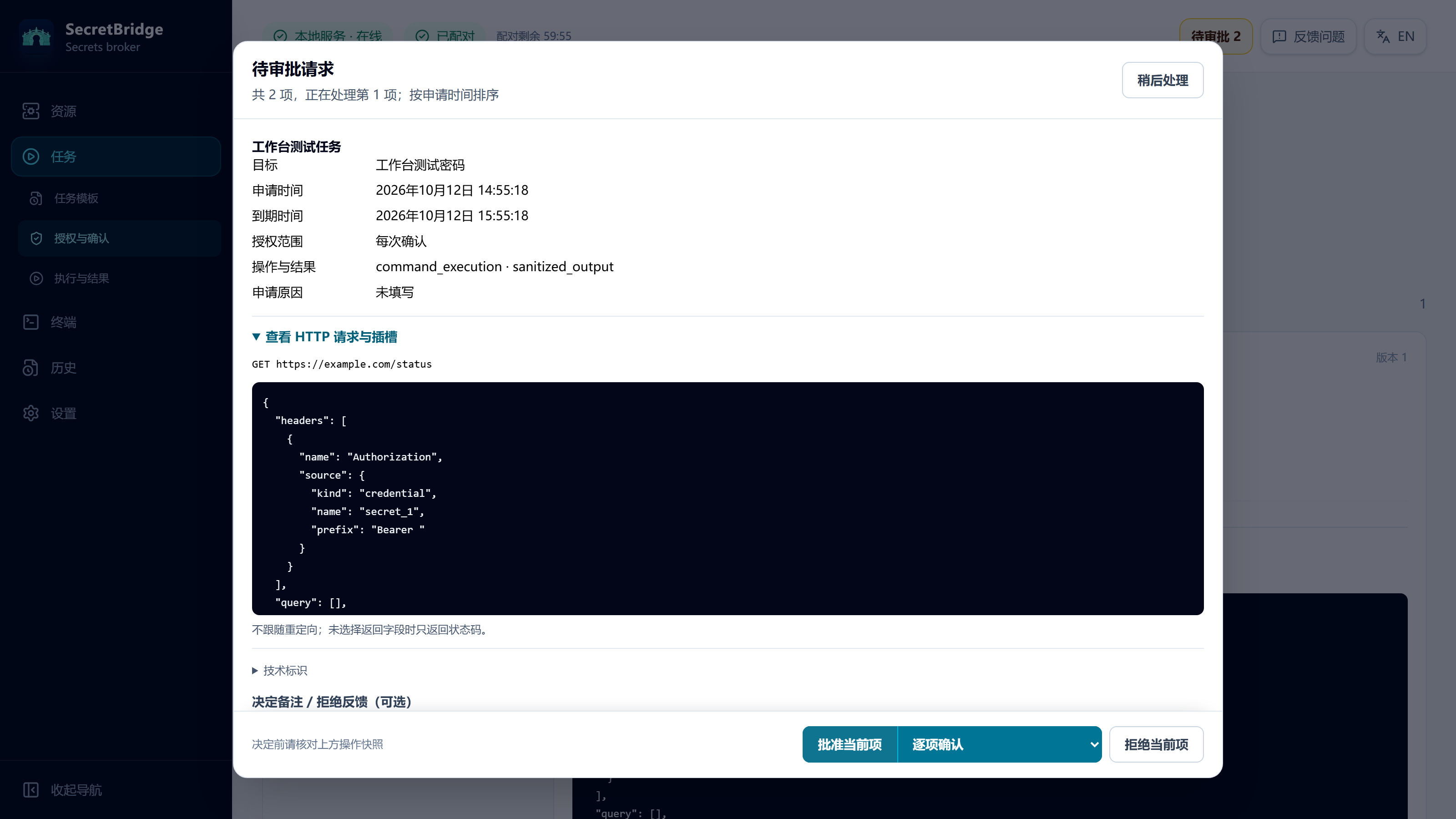
Resources & credentials
Maintain address, account, authentication and secret status together. Secret values use the native OS store; neither the console nor MCP provides general secret retrieval.
Read the guideTasks & authorization
Fix the operation template, ordinary parameters, versions and result scope. Approval binds a snapshot and is rechecked on expiry, revocation or configuration changes.
Read the guideManaged terminals
Local and SSH continuous terminals retain sessions and output. The user controls authorization while the broker owns connection and execution lifecycles.
Read the guideConnectors & results
HTTP, databases, SSH, SFTP, Git HTTPS and fixed programs use constrained configuration. Output is filtered before return and storage.
Read the guideRuns & history
Connect tasks, approvals, runs and terminal history. Filtering handles known secrets and related echoes; it does not classify every business-data disclosure.
Read the guideBackup & recovery
Configuration export and credential backup are separate workflows. Check formats and keep an independent backup; rollback is not a database downgrade.
Read the guideControl credential-bearing work.
Use it for database queries, API calls, SSH maintenance and file tasks. Define the target, authentication reference, parameters and output limits before execution. Approval cannot reverse operations already submitted remotely.
Understand the trust boundary · Explore integrations and connectors
Product content based on SecretBridge 0.3.1 · a82cd12 · Reviewed 2026-10-12